Blade Runner is one of the most defining films in science fiction history. It may not be as popular as Star Wars or even Star Trek, but over the past 40 years, it has become a cult favorite among science fiction fans and one of those enduring stories that truly stands the test of time. I was excited when they decided to make a sequel in 2017, and it absolutely delivered by continuing the story established in the original film. Now, we have a limited series that continues the stories of both films, and let me start by saying that if you’re a Blade Runner fan, this is a must-watch series.
However, this isn’t necessarily a series for casual science fiction fans. Let’s be honest: Philip K. Dick is an acquired taste. He never really wrote casual science fiction stories with simple themes. His work dealt with heavy philosophical questions that challenged audiences to dig deeper and reexamine some of life’s biggest questions concerning identity, humanity, and the role these concepts play in a world oversaturated with technology and controlled by corporations that are simply too big to fail.
Blade Runner deals with those same themes when it comes to machines created by human beings. Does a machine have an identity of its own, or is it simply a slave to its creator? This is precisely why Roy Batty’s death in the original Blade Runner is so profound. He was a replicant who didn’t want to be a slave to his programming or be limited by the lifespan his creators had assigned him. He wanted something more: the freedom to determine his own existence.
Blade Runner 2099 explores these same themes. Set 50 years after the events of the previous film, the series takes us into a world dealing with the aftermath of the replicant revolution. Replicants are now largely in control of society, yet they remain limited by their lifespans. They are still, in many ways, slaves to their creators. Once again, the question of identity becomes relevant: Do you truly have an identity if you cannot control your own fate and remain a slave to your programming?
I genuinely enjoyed this series for what it is. While it isn’t perfect, it does an excellent job capturing the aesthetic and, more importantly, the heart of Blade Runner. The filmmakers don’t attempt to recreate the source material or reinvent the lore, and that’s probably the most brilliant aspect of the series. Creator Silka Luisa does a magnificent job staying true to the mythology established by Philip K. Dick and further developed by Ridley Scott in the original film. She understands her audience and has created a show specifically for Blade Runner fans.
So many times, as critics, we complain about studios and showrunners attempting to reinvent established franchises without ever truly understanding the original source material. Thankfully, that isn’t the case here. However, this is a series made for a very specific audience. It’s for the fans of Blade Runner. While some critics may argue that catering to an established fan base makes for a less compelling story, sometimes fan service is exactly what’s needed when you’re already playing in someone else’s sandbox.
Now, I admit that I’m a huge fan of Philip K. Dick, the original novel, and both Blade Runner films. That said, I’m still going to be critical of certain aspects of the story. But let’s start with what makes Blade Runner 2099 worth watching.
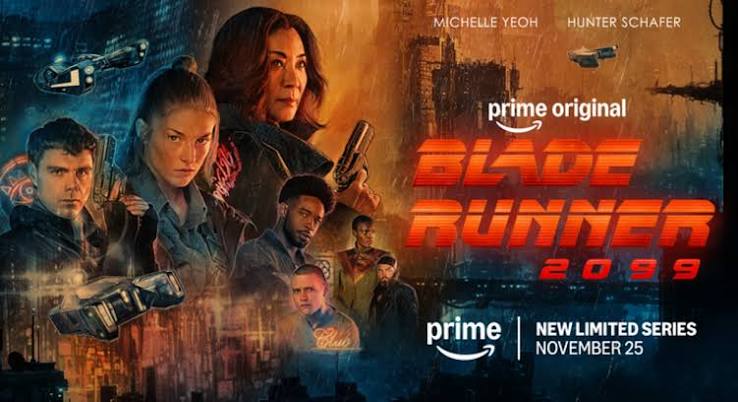
The story centers on a replicant named Olwen, played by Michelle Yeoh, who is not only a cop but is also approaching the end of her lifespan. The other main character is Cora, a human who disguises herself as a replicant. The two develop something of a buddy-cop relationship as Olwen pursues a runaway replicant who is scheduled for termination. However, the story eventually expands into a much larger conspiracy that reaches all the way back to the creation of replicants and the original plans of their creator, Dr. Tyrell.
With themes that directly connect to the original film, along with plenty of great nods to both previous movies, the story immediately drops you into the world of Blade Runner. Despite taking place 50 years after the last film, everything feels remarkably familiar. As I’ve mentioned, the series truly captures the aesthetic of the Blade Runner universe.
The strongest aspect of the series is undoubtedly its two lead performances. Michelle Yeoh is absolutely fantastic, as you would expect. From her work in some of the greatest Asian action franchises to being a memorable Bond girl and appearing in Star Trek, she feels right at home in this world. Hunter Schafer is equally fantastic in her portrayal of Cora. Both actresses deliver performances that will leave you wanting more, even after the eight-episode limited series comes to an end.
Hunter Schafer may not be as well known among nerd audiences, considering her breakout role came from the series Euphoria, but horror fans will certainly recognize her outstanding performance in the film Cuckoo a couple of years ago.
The somewhat contentious relationship between these two characters is what drives the story, especially as they begin unraveling the mystery surrounding the runaway replicants. There’s also an additional layer of mystery surrounding Olwen’s suspicions about Cora’s true identity and whether she is really human. If Olwen discovers the truth, what will she do with that information?
With great action sequences, solid pacing, and a mystery that gradually peels back the layers of the established Blade Runner mythology, this is a story that fits remarkably well within the franchise. It also manages to recreate the same feeling audiences experienced when watching the original film, capturing much of what made that movie so special in the first place.
However, as a fan, I have to ask an important question: Would this story have been better as a 150- to 180-minute movie?
There are plenty of great things this series accomplishes, but it doesn’t really hit its stride until the final four episodes. I’m not suggesting that the first four episodes are bad. They take their time establishing the world, introducing the characters, and giving us reasons to care about the central mystery. But, if I’m being completely honest, those first four episodes can feel like a bit of a slog at times.
There’s certainly a lot of story to tell, especially when you’re exploring a world set 50 years after the previous film, where replicants have become largely responsible for controlling society. On one hand, I understand why the filmmakers needed time to establish the world and the circumstances surrounding these characters. But on the other hand, couldn’t all of this have been accomplished in a three-hour movie?
Overall, I think this is a great series that adds something meaningful to the larger Blade Runner mythology while exploring the same philosophical questions and themes established by the original film. However, filmmakers also need to understand when to get to the point. When you’re creating a story within an already established universe, there’s a balance between expanding the mythology and giving audiences more than they actually need.
I appreciate what the filmmakers have accomplished across these eight episodes, but I also recognize that quite a bit could have been trimmed without sacrificing the story or its characters. You could still tell a compelling story about identity, playing God, and finding one’s place in the world without necessarily stretching it across eight episodes.
My criticisms are relatively minor because I genuinely love the story, and I believe fans of Blade Runner will appreciate what this series brings to the franchise. Still, I can’t help wondering whether less might have been more. Then again, sometimes a slow build makes for an incredibly rewarding payoff. If you start watching and feel like the series is taking too long to get somewhere, stick with it. The payoff is absolutely worth it.
Blade Runner 2099 offers rich, sympathetic characters, just like the previous films. The performances are excellent, and the series does a remarkable job capturing the same look, atmosphere, and feel of the original movie. Yes, some viewers might consider it excessive fan service, but when you’re dealing with such intellectually demanding science fiction, staying true to what made the original stories special is not necessarily a bad thing.

As critical as I might be, I do think stories within the Blade Runner universe might benefit from shorter seasons, perhaps six episodes at most. There’s so much to appreciate about this universe and the way it continues to expand upon the mythology established by the previous films, but this kind of science fiction simply isn’t for everyone, especially when the story seems too bleak
And that’s okay.
I’m glad the filmmakers understood their audience when making Blade Runner 2099. They didn’t try to create something that would appeal to absolutely everyone, and in doing so, they avoided diluting the story or sacrificing the philosophical depth that makes this franchise so special. It doesn’t have to be everyone’s cup of tea to be great!
My final verdict: Blade Runner 2099 is absolutely made for the fans of the franchise, and it is definitely NERD APPROVED!